


Villeroy & Boch Brand's History


Brands > Innovation
Innovative Strength Since 1748
For over 270 years, innovations have been part of Villeroy & Boch's corporate culture. They have helped to forge a positive image and drive the brand's success in over 125 countries. As well as high-quality design, the guiding aims behind our innovations are always functionality and added value for our customers. You can find a selection of Villeroy & Boch's major innovations here.
“
It is vitally important that an innovation culture is enshrined at the highest level of a company and made an important priority
DR PETER DELWING (INNOVATION MANAGER)
“

Manufacture Rock
The Manufacture Rock collection is inspired by slate, whose many layers of rock, formed millions of years ago, constantly reveal new patterns, structures and colours. The lifelike slate surface of the tableware made of solid-coloured, black Premium Porcelain, reproduced in fine relief with a hint of glaze, has a fascinatingly authentic feel.

NewWave – An Eternal Shape
Anyone familiar with Villeroy & Boch will also know NewWave: since its launch in 2001, NewWave has been an essential part of the Villeroy & Boch range. what makes the range special: Villeroy & Boch's NewWave series represents a break from the traditional rounded shape of crockery, creating a completely new design with an original wave effect. In 2004, the special design and innovative die-casting process used to produce the cup, allowing the handle to be harmoniously integrated in the overall shape, earned Villeroy & Boch the "Innovationspreis der deutschen Wirtschaft" [German Economy Innovation Award] for its NewWave collection.
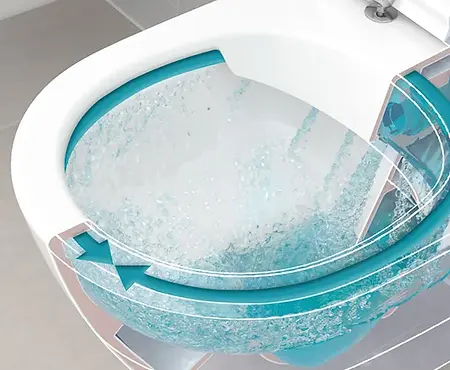
DirectFlush Toilets – Intelligent Engineering
Instead of a conventional rim, Villeroy & Boch DirectFlush toilets have an intelligent flushing system: it rinses the entire inner surface of the bowl without splashing - thanks to a splash guard at the top of the bowl and the higher positioning of the water jets. Consuming just 3 or 4.5 litres of water per activation, DirectFlush ensures maximum flushing efficiency. The DirectFlush models are completely glazed for quick and easy cleaning. In 2015, sales of DirectFlush and HygieneFlush toilets doubled in comparison with the previous year.

TitanCeram – A Material With A Future
TitanCeram is an innovative material bringing together experience from over 260 years of ceramic production and developed specially for high-quality premium designs. The new ceramic material passes through specially adapted production steps to allow the creation of products with uniquely precise shapes. TitanCeram stands for outstanding design highlights, such as the Octagon pedestal washbasin, a novel and precise shape featuring extremely thin walls and sharply defined edges.

ViClean – A New Dimension Of Toilet Culture
Hygiene, comfort, sustainability and innovative design are the convincing features of Villeroy & Boch's shower-toilets. Shower-toilets are an established part of toilet hygiene in Asia. The time has now come to convince European consumers of the benefits of gentle and personalised intimate care at the touch of a button. In cooperation with leading experts and well-known designers, Villeroy & Boch has succeeded in combining both the functionality and aesthetics of a toilet and bidet in its ViClean concept.
OUR RICH HERITAGE SINCE 1748
For over 277 years, Villeroy & Boch has been at the forefront of revolutionizing the way we live. With a deep connection to European culture, we have been bringing exceptional products into your daily life, from the bathroom to the dining table.
UNLEASHING THE POWER OF DESIGN AND INNOVATION
At Villeroy & Boch, we believe in pushing boundaries and constantly striving for innovation. Our commitment to ongoing advancements can be seen in every aspect from out production processes to the materials we use, and the functionality of our products. We go above and beyond to ensure your satisfaction.



The Company's History
Learn more about the beginnings of the company and go on a journey through the most important events in the history of Villeroy & Boch AG.
1700
A WORLD COMPANY EMERGES
Alt Luxemburg
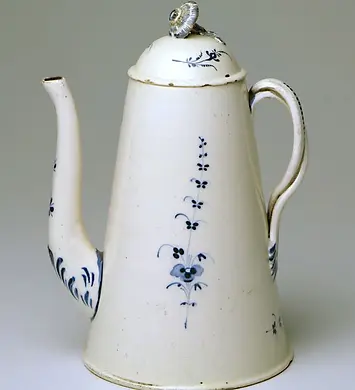
Popular around the world, the Alt Luxemburg crockery series is a Villeroy & Boch evergreen. It dates back to the Brindille pattern which was introduced by Pierre-Joseph in 1770. The creatively gifted entrepreneur fashioned a series of artistic ceramic items including a rocaille hanging flowerpot and a crucifix base with snake symbol – both exhibits can to be found in the Mettlach Ceramics Museum.
Ceramics Manufacturers Villeroy

Together with two partners, the businessman Nicolas Villeroy acquires an earthenware factory in Vaudrevange, which is today called Wallerfangen. In 1797 he becomes its sole owner. Villeroy is one of the first ceramics manufacturers to use coal as fuel. He calls in specialists from England and France to modernise production. Above all, he experiments with pattern printing. From 1815 he applies the copper printing process which enables products to be offered more cheaply.
Luxembourg

Luxembourg is one of the Bochs' initial sales markets. Due to this fact Francois' son, Pierre-Joseph, submits a request to the Austrian government for permission to set up a manufactory in the Province of Luxembourg. Of the numerous persons who apply, he receives authorisation from Empress Maria Theresia. The new factory at Septfontaines/Luxembourg is also a major step from manufactory operations to early industrial serial production. As a sign of special recognition, the Faiencerie is permitted to call itself Manufacture Impériale et Royale.
The Birth Of The Company

Francois Boch bears the title "Bombardier du Roi", royal cannon founder. The iron founder from village of Audun-le-Tiche in Lorraine, however, decides to start a new career. In 1748, together with his three sons, he begins manufacturing ceramic crockery. This marks the birth of the Villeroy & Boch company.
1748
1766
1770
1791
1800
FROM METTLACH TO THE WHOLE WORLD
The First Ceramic Sanitary-Ware Production

The first signs of ceramic sanitary-ware production are seen. The Wallerfangen Faiencerie begins manufacturing "water pipe articles", Villeroy & Boch's first items of ceramic sanitary ware. Washing vessels, including numerous specially-produced items, for example, for Louis II, the Bavarian "fairytale" King.
Export Markets Are Opened

Eugen von Boch (4th Boch generation) recognised exactly where the markets of the future were located. He sets up the earthenware factory in Dresden so as to be able to open up new export markets in the north and east of Europe more easily and supply them better from here. Production is originally geared to crockery, but is extended only a short time later to include tiled stoves. The greatest contribution to the Dresden factory's reputation is made by the special department for shop interiors, after production of tiles had also been assumed here. The most famous example is the Dresdner Milchladen (Dresden Dairy), which is today one of the city's greatest tourist attractions. With its hand-worked and hand-painted tiles, the café at the Mettlach Ceramics Museum is an almost authentic version of this historic dairy. (see 2007)
Mettlacher Platten

Many a good idea for the present can be won from the wealth held by history. When archaeologists came across a Roman floor mosaic in the vicinity of Mettlach, Eugen von Boch was entrusted with its restoration. Inspired by this archaeological find, he and his technicians begin experimenting with material for tile manufacture. They develop a production process which combines tremendous wear resistance with a sensationally beautiful appearance. Manufactured in Mettlach since 1852, these tiles achieve great success throughout the world under the name of Mettlacher Platten. Demand is so great that a factory specialising in tile manufacture is built in 1869 – the Mosaic Factory. In 1879 Villeroy & Boch takes over a further factory in Merzig. They develop into the world's largest manufacturer of plants for wall and floor tiles anywhere in the world.
World Exhibition

The Prussian Minister for Economic Affairs chooses Villeroy & Boch to take part in the famous World Exhibition in London. On a magnificently presented stand the company displays innovative everyday crockery and decorative ceramic items made of bone china and elaborately decorated stoneware. London was the start of a series of prestigious appearances at the great World Exhibitions of the 19th and early 20th century, including Philadelphia in 1876, Paris in 1878 and 1900, Chicago in 1893, St. Petersburg in 1901 and St. Louis in 1904.
Complete Offer As Corporate Strategy

The full-range concept – today an integral element of the corporate strategy – can be traced well back into the 19th century. In 1843 Villeroy and Boch set up the Cristallerie in Wadgassen. An attractive product range extension: by producing glasses the company was able to round off its crockery range, thus improving its market opportunities both in Germany and abroad. Every German town received regular supplies. From 1847 larger consignments were sent to Paris, Warsaw and London. A new connection to the Mannheim railway junction facilitated export to Moscow and St. Petersburg. Distribution was also extended to Scandinavia, Italy, Spain, Greece, Switzerland and Turkey. From around 1850 the first consignments were sent across the Atlantic to North and South America.
Merger Between Boch & Villeroy

The factories of the entrepreneurs Boch and Villeroy are not far away from each other. Now and again the two competitors, who successfully market their products beyond Germany's borders, even meet. But in order to exist in Europe's economic framework, particularly alongside the dominant English industry, the two agree to merge. Villeroy & Boch is born. It combines the strengths of both sides: creative talent, entrepreneurial spirit, innovative power and production capacity, and is one of the 19th century's first global players.
Production Of Earthenware

While the second Boch generation achieved an optimised product quality by experimenting with materials, the third generation made a decisive leap with Jean-Francois Boch. Trained at the École de Sciences in Paris, the entrepreneur successfully develops a type of earthenware which is bright white and extremely hard. It looks deceptively like porcelain, but could be supplied considerably cheaper. This path democratised tableware. As a result of this early innovation, porcelain – the previously rare and costly, precious treasure reserved solely for the nobility – if now affordable for broad classes of society. The products are not only well-accepted on the market, but also officially. At the first Prussian trade exhibition in Berlin in 1822, the Bochs receive the gold medal, which is followed by many national and international awards.
Social Commitment

As an entrepreneur Pierre-Joseph is one of the social pioneers of the early 19th century. He founds the social institution Antonius Guild in Septfontaines. Its fundamental elements are insurance to cover illness, accidents, and disability, and also a pension fund. It is a comprehensive social insurance to which both employees and the company pay contributions. Antonius Guild benefits are considerably more extensive than those which later became law. They serve as a model for Bismarck 70 years later when he develops the first German social insurance scheme. In 1857, Nicolas Villeroy's daughter Leonie and her husband Adolphe de Galhau set up the Sophie Trust to support families in need.
Acquisition Of The Old Abbey In Mettlach

Jean-François Boch buys the former Benedictine abbey in Mettlach on the River Saar. In the baroque building he sets up a highly-modern, extensively mechanised system of tableware production. He designs many of the production machines himself. His inventions smooth the way for manual ceramic manufacture to be replaced by industrial production. Today, the baroque building is the corporate headquarters of Villeroy & Boch.
Large-Scale Production Of Bathtubs & Toilets

In the 19th century, significant scientific insights create the foundations of modern hygiene. An essential contribution is made above all by sanitary products, which are still not widely used around 1900. At this time Villeroy & Boch starts large-scale production of bathtubs and toilets. A key reason for this undertaking is the improvements the company had successfully made in the production technique and the material. The key to large-scale series lay in the slip casting technique used to cast the liquefied ceramic in moulds. When Villeroy & Boch then also introduced traditional fireclay – a particularly hard ceramic which hardly warps during firing – into sanitary-ware production, large-scale manufacture could commence. Bathroom furnishings became affordable for the average home. This is an important contribution towards democratising bathing and hygiene
Project Business Begins

Villeroy & Boch creates a floor mosaic for Cologne Cathedral, a building of high national symbolic value which was restored in the 19th century. This 1,300 squaremetre mosaic is produced and laid within a period of five years. Besides the industrial manufacture of crockery and tiles, Villeroy & Boch's ateliers create numerous items made specially to order. The company becomes a supplier – above all of crockery – to European ruling houses and to the upper classes. In the construction sector too, numerous prestigious premises all over the world are built or equipped with Villeroy & Boch products, e.g. the Bolshoi Theatre in Moscow or the Castle of the Prince of Thurn and Taxis in Regensburg. In the commercial sector, swimming pools, hotels, banks and hospitals, etc. have been equipped with products from Villeroy & Boch from the 19th century through to this day. Its own capacity together with the artistic and technical know-how of its ateliers and planning offices enable the company to design and realise highly individual projects.
Vincent Van Gogh

Vincent van Gogh paints a portrait of his friend Eugène Boch, which today hangs in the Musèe d'Orsay in Paris. Van Gogh always carried this painting, entitled Der Dichter (The Poet) with him on his travels. After his death, van Gogh's sister-in-law gives the painting as a gift to Eugène who bequeaths it to the Louvre in 1942. Anna and Eugène Boch are themselves neo-impressionists and have frequent contact with prominent artists of their day, such as Toulouse-Lautrec, Ensor and van Gogh. Van Gogh's letters are proof of the deep friendship he shared with Eugène.
Artistic Terracotta Items

Villeroy & Boch takes over and modernises an earthenware factory in Merzig, where it launches another new range of products – artistic terracotta items. Management of the terracotta atelier is assumed by Professor Alexander Schmidt from Thuringia. At the same time the technicians successfully improve the material so that its robust and weatherproof qualities are superior to those of other building materials, even natural stone. This building adornment known as terracotta, is marketed throughout the world and used, above all, for prestigious properties such as stately homes, cathedrals, banks and castles, one of which was Schloß Herrenchiemsee. Examples of this form of architectural ceramic still in existence today have lost none of their original beauty, while stoneware ornaments would now be weathered and covered in moss.
1809
1812
1829
1836
1843
1851
1852
1856
1876
1879
1888
1890
1899
1900
BETWEEN WORLD WARS, INNOVATIONS AND EXPANSION
Core Business Of The Group

As a lifestyle supplier Villeroy & Boch focuses on a comprehensive, diversified range which allows the supply of complex interior design solutions. "The single-source bathroom", "the completely-laid table" and "tiles for the private and commercial sector" constitute the Group's core business. In order to be able to offer this comprehensive product range, Villeroy & Boch makes further acquisitions: in 1999, Ucosan B.V., Netherlands, manufacturer of plastic bathtubs, whirlpool and steam-shower systems, in 2000, Gustavsberg, Sweden, manufacturer of bathroom ceramics and fittings and in 2001, db – Das Bad, Austrian manufacturer of bathroom furniture.
The Company's 250th Anniversary

The company's 250th anniversary. Many leading European politicians take part in the large-scale celebration gala in Mettlach, including the Federal Chancellor at that time, Helmut Kohl, Luxembourg's Minister President, Jean-Claude Juncker, France's Minister of Finance, Mr Strauss-Kahn and Saarland's Minister President, Oscar Lafontaine. In his official address, Helmut Kohl described Villeroy & Boch as " Europeans of the first generation". In the same year, Wendelin von Boch – the founder-family's eighth generation – is appointed Chairman Management Board. Under his direction further modernisation measures are carried out within the Group: he initiates the change in Villeroy & Boch's corporate direction, converting it from a production-oriented ceramics producer to a lifestyle supplier. At the heart of this paradigm shift is the sales and marketing concept The House of Villeroy & Boch, the extensive implementation of which is one of the Group's strategic goals. This concept is based on an integral, extremely differentiated range, offering individual combination alternatives. An innovative presentation of products in realistic, emotionally appealing room situations is tailored to suit each lifestyle. In order to round off this consistently integral range, Wendelin von Boch continues the diversification strategy by making further acquisitions. In view of the changed market conditions throughout the world, von Boch also pushes ahead with the company's internationalisation and globalisation in the years which follow and focuses activities on the brand.
Villeroy & Boch Expands In Hungary & Romania

Villeroy & Boch acquires a majority interest in Aföldi Porcelàngyàr, the largest manufacturer of ceramic sanitary ware in Hungary, and four years later in Mondial S.A., the Romanian manufacturer of ceramic sanitary ware. In the years which follow the company makes further strategic acquisitions which enable Villeroy & Boch to extend its product portfolio and at the same time open up the respective domestic markets. (See 1999)
Villeroy & Boch At The Stock Exchange

Following thorough company restructuring, strategic reorientation and the conversion of Villeroy & Boch KG into a public limited company, Villeroy & Boch starts trading on the stock exchange. This step marks the beginning of a new phase of opening up capital markets.
Specialising In Hotel Porcelain

A second tableware factory, specialised in the manufacture of hotel porcelain, is put into operation in Luxembourg. Today, the Hotel Division is one of the world's most successful suppliers of tableware for the hotel and catering sector. This is not only because of its extensive, high-quality range of products, but also due to its polished, sophisticated service. Its four lifestyles and special, custom-made designs allow Villeroy & Boch to respond individually to the character of each respective establishment. Middle to high-class hotels and restaurants throughout Europe, America and Asia are equipped with Villeroy & Boch tableware.
The First World War & The Consequences

As a result of World War I, the Saar Region is detached from the German Reich. Since the factories in that area are no longer available to supply the German market, factories are purchased in Bonn, Torgau and Breslau. In the same year the Holland Tunnel is built under the Hudson River in the USA, between New York and New Jersey. Villeroy & Boch supplies 10,000 square metres of tiles for this construction (see photo).
Second World War

Villeroy & Boch's factories in all parts of Germany suffer considerable damage during World War II. When the war ends, the factories in Breslau, Dresden and Torgau are expropriated and the factories in Saarland integrated into the French economic region until the monetary reform in 1959.
Local Engagement

Opening of the SOS-Kinderdorf (family-structured village for orphans) in Hilbringen – the third of its kind in Germany – in the presence of the wife of Mr Lübke, the Federal President. The Kinderdorf is built on the initiative, and with the extensive support of Luitwin II von Boch and his wife, Beatrice. Even construction planning for Saarland's Kinderdorf is in the hands of Villeroy & Boch's construction department.
Cooperation With Luigi Colani

Commissioned by Villeroy & Boch, Luigi Colani develops a completely new bathroom concept which totally redefines the bathroom as a living space and place for regeneration. He begins by concentrating on the room's ergonomic aspect, and achieves optimised functionality and distinctive colourfulness in all areas. It is also the first concept which creates a consistent line of design for every bathroom element. In so doing he provides inspiration for the designs of decades to come and revolutionises the bathroom industry.
The Papal Tableware

Villeroy & Boch continues the tradition of its own subsidiary Heinrich, which has supplied popes and renowned dynasties since 1955, and manufactures papal tableware: in 1980 Wendelin von Boch presents the crockery at a private audience with Pope John Paul II in 1980, and with Pope Benedict XVI in 2007.
Advertising Campaigns With Helmut Newton

Villeroy & Boch launches one of the most spectacular and artistically appealing advertising campaigns of the Eighties. Star photographer Helmut Newton is engaged to create 14 advertisement motifs for the Sanitary Ware Division. In the resulting black and white photographs, long-legged models present the new bathroom products in Newton’s signature style. The campaign is voted campaign of the year by a jury of advertising experts from Cosmopolitan magazine. A special exhibition, "Ahead of their time – Helmut Newton and Villeroy & Boch", held 20 years later at the Ceramics Museum looks back at the pioneering, once provocative advertising campaign.
Collaboration With Designers

Up to now a limited partnership, the company is converted into a public limited company. The capital of the new Villeroy & Boch AG remains in the family. The year 1987 marks the beginning of a cooperation with one of our era's most illustrious designers, Paloma Picasso. After designing a tile collection, she goes on to create tableware, cutlery and crystal collections. Her tableware designs mirror, above all, the origins of her design in the area of jewellery. Quality of design forms a central, connecting theme which runs throughout the company's history. In addition to the company's own designers, world-famous designers have also worked for Villeroy & Boch since the 19th century. These include van de Velde, Olbrich and Behrens. These three in particular give Villeroy & Boch products their typical, distinctive style. Luigi Colani, Matteo Thun, Keith Hearing, Conran, Kenzo, Joop, Roberto Capucci, Isabelle de Borchgrave, Helen von Boch, Maggy Champsaur, Rainer Moll and Frog Design are among the internationally renowned designers who have been engaged by Villeroy & Boch in the second half of the 20th century.
1920
1930
1939
The Bauhaus & Art Déco Styles Dominate Design

Based on a rationally mundane, purpose-orientated styling, the Bauhaus style and the elegantly luxurious art déco style dominate the design of the Twenties and Thirties. This is also reflected in the Villeroy & Boch product range during these decades. Around the turn of the century, Henry van de Velde – founder of the "Kunstgewerbliche Seminar", the forerunner organisation to Bauhaus – had already created designs for Villeroy & Boch. In 1919, together with Walter Gropius, he set up the Bauhaus. Peter Behrens – co-founder of the Deutsche Werkbundes, (federation of architects, artists and builders) – also creates crockery and tile designs for the company.
1959
1960
New Types Of Porcelain Emerge

Production of vitreous porcelain begins at Septfontaines in Luxembourg. Owing to its hardness and resistance to scratches, this material is also used in the catering sector. In addition, Villeroy & Boch is later able to successfully develop the material to produce Fine Vilbo China, which combines refined porcelain white with the outstanding functional qualities of vitreous porcelain.
1971
1975
Overseas Activities Intensify

The first large-scale shipment of crockery goes to Japan. At the same time exports to the USA are stepped up. A series of special editions is created for this market. The crockery sector's name change to Tableware signalises the move towards a new integral range. Designer Helen von Boch creates emphatically modern series, some of which are inspired by the Far East, the best known of which is the Kugel (globe). Concealed inside is a complete dinner service and its production requires the highest degree of technical skill.
1976
1980
First Villeroy & Boch Bone China Ranges

Villeroy & Boch takes over the highly-traditional Heinrich porcelain manufactory in Selb. Since 1980, this factory has manufactured bone china, which Villeroy & Boch was the first producer to market on the European Continent. (The company had already manufactured individual series as early as the 19th century.) Bone china is regarded as the most refined porcelain of all and its manufacture requires special technical know-how. This high-quality porcelain not only extends the company's range of materials, but also enables new markets to be opened up.
1982
1985
1986
1987
1989
1990
Restructuring The Company

The Villeroy & Boch company is restructured. In view of sustained stagnation in the construction industry and a tremendous concentration in the retail sector, market development is given a new basis. Customer support and supply is no longer carried out by the individual factories, but centrally. The company is divided into three divisions: Tiles, Sanitary Ware and Tableware/Crystal. By using this "single source" strategy, Villeroy & Boch is able to respond to the requirements and wishes of its market partners in the retail, trade and commercial sectors promptly, flexibly and with a close focus on customer needs.
New Impulses With Mix & Match
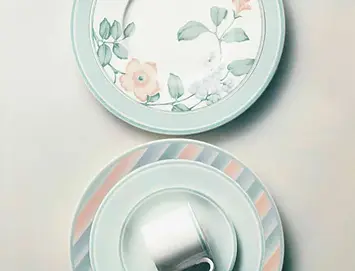
Changes in society combined with a rising number of single households give rise to new lifestyle and consumer habits which also affect the tableware sector. Villeroy & Boch's innovative Mix & Match concept is a response to this changed way of life. It enables patterns to be freely combined and subsequent purchases to made according to individual demand, with the effect that consumers are not compelled to buy a 12-piece service. On the contrary, they are able to use variable, coordinated tableware designs to create a constantly new look for their laid table. The Mix & Match products, which introduce new market stimuli, become an international success. They continue to influence the appearance of table settings and above all, modern tableware design to this day.
1992
1998
1999
2000
TAKING NEW PATHS IN THE NEW MILLENNIUM
Modern Exhibition Concept In Ceramics Museum Mettlach

The Keramikmuseum Mettlach (Mettlach Ceramics Museum) provides a new home for the extensive ceramics collection. Presenting both the tradition and modernity of the Villeroy & Boch company in an exciting, dramatic relationship, this directional exhibition concept creates the ideal setting for the valuable exhibits from the last four centuries. Fine examples give visitors a first-hand experience of the change in everyday culture.
Expansion In Key Growth Markets

A branch of the Bathroom and Wellness Division is opened in Shanghai for the purpose of developing the Chinese market. China's brand-oriented consumers enjoy a high level of purchasing power and hold great potential for Villeroy & Boch. This branch represents a further step towards developing the company's position in major global growth markets.
Reorganisation Of The Company

Villeroy & Boch sells 51% of V & B Fliesen GmbH to Eczacibasi – a highly-competitive Turkish industrial group. Operations continue at the factory locations in Germany and France. Management Board restructuring following the move of its Chairman, Wendelin von Boch to the Supervisory Board. He is succeeded by Frank Göring, who is responsible for the two divisions Bathroom and Wellness and Tableware. Management Board member Manfred Finger heads the Finance and Personnel divisions, and is also Director of Human Resources. The new Management Board unit, Corporate Development, is under the direction of Volker Pruschke. Distribution strategy will focus on further internationalisation: numerous new points of sale will come into existence in the tableware sector in 2007. These will be, above all, Houses of Villeroy & Boch in the new growth markets of China, India and the Arab States and will include, for example, Beijing, Bombay, Haiderabad, Casablanca, Qatar, Algeria, Jordan and Saudi Arabia. The Ceramics Museum in Mettlach acquires an unusual café, designed according to blueprints from the 19th century. During that period Villeroy & Boch designed and completed numerous commercial properties. These include the Dresden Dairy of 1892, on which the design of the café is based. Virtually all furnishing elements are made of artistically-patterned tiles. As it is such a unique example of interior design, the museum café in itself offers visitors a further art delight.
Competitiveness Is Optimised

Against the background of a global financial crisis, affecting the sales situation in both divisions, Villeroy & Boch passes a package of measures aimed at increasing competitiveness. It involves the specialisation of locations, creating centres of competence and continuing to progressively automate production processes.
TitanCeram
A milestone in ceramic research: drawing on 270 years of ceramic experience, a new material – TitanCeram – was developed, which is used specifically for very delicate, high-quality designs. The special composition of natural raw materials such as quartz, feldspar and clay with titanium dioxide enables elegant designs with high stability. TitanCeram allows the production of precise washbasins with extremely thin walls and clearly defined edges, which are also very robust.
Visit By The German Federal President

In March 2018, Villeroy & Boch welcomed a distinguished visitor to the company’s headquarters. As part of his inaugural visit to Saarland, the Federal President Frank-Walter Steinmeier, accompanied by his wife Elke Büdenbender, came to our company and found out about the history of the ceramic manufacturer on a guided tour through Keravision. Also current topics regarding the new working environment were important to the president. Villeroy & Boch employees had the opportunity to talk to the Federal President during a concluding discussion session in Factory N°09’s market square.
The Evolution Of An Icon

Almost 50 years after Helen von Boch created the fascinating sphere, Villeroy & Boch has relaunched the unique design idea and presents La Boule, a modern reinterpretation of the design masterpiece.
Award-Winning Innovation

Villeroy & Boch is honoured for its exemplary innovation work as one of the "TOP 100 Innovators" 2022 in the German SME sector.
Successful Acquisition Of All Operating Companies of the Ideal Standard Group

Ideal Standard is now part of the Villeroy & Boch Group.
2002
2003
2004
Restoration And Return Of Schinkel Fountain

Following extensive restoration work carried out by Villeroy & Boch and the Deutsche Stiftung Denkmalschutz (German Foundation for the Protection of Ancient Monuments), the Schinkel Fountain returns to its former place in the Old Abbey Park. The fountain was given to Jean-Franҫois Boch as a present in 1838, on the occasion of a visit by Fredrick William, Crown Prince of Prussia. It was designed by the Berlin Court Architect Karl Friedrich Schinkel.
2005
2007
2008
2009
Innovation NewWave

Villeroy & Boch receives the German Business Innovation Award in the "medium-sized business category" for the design and production technique of its NewWave cup. This award confirms a corporate strategy in which innovative activity holds a key position for international market success and brand image.
Internationalization In Asia

Villeroy & Boch continues its strategy of internationalisation by purchasing Nahm Sanitaryware Co. Ltd. in Bangkok. In so doing, it has created a platform which will enable more efficient use to be made of the high sales potential in the Asiatic region. In order to expand its range of internationally successful bathroom furniture and strategically develop its position in the bathroom-furniture sector, Villeroy & Boch takes over Sanipa, the bathroom-furniture manufacturer in Treuchtlingen, Germany.
2013
2015
DirectFlush
Intelligent engineering: by launching DirectFlush technology, Villeroy & Boch has successfully brought a new generation of toilets to market. The intelligent flushing system provides more hygiene with less cleaning and low water consumption. A DirectFlush toilet only consumes 3 or 4.5 litres of water per flush with maximum flushing efficiency. This innovation has quickly became popular. In 2015, sales of DirectFlush and HygieneFlush toilets doubled in comparison with the previous year.
2018
2018
Factory N°09 Completed

Villeroy & Boch employees from the Communication departments have been working in a new office and conference centre in Mettlach since February 2018. Factory N°09 marks the completion of an important part of the “Mettlach 2.0” site development project. Today, the only reminder of the incarnation of these former warehouse and production premises is the name Factory N°09. With its diverse spectrum of working spaces, the new building has broken away from conventional office structures: about 4,000 square metres provide a tailored work space for each activity.
2019
2020
2021
2022
2023
2024
Factory N°09
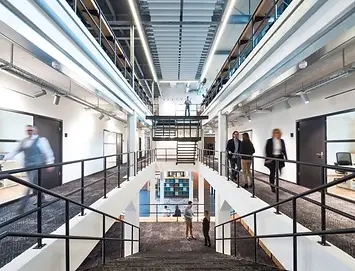
Exceptional combination of history with modern working environments on an innovative and technologised space: in March 2019, Fabrik N°09 will be awarded the "ZIA Office Award 2019" by the Zentraler Immobilien Ausschuss e.V. (Central Real Estate Committee) in Berlin in the category "Hardware".
From Tableware To Dining & Lifestyle

The Division positions itself for the future: With effect from 01 January 2021, Villeroy & Boch is renaming its Tableware Division as Dining & Lifestyle. The new name reflects the changes within the Division. This is because Villeroy & Boch offers much more than tableware, and the product portfolio has become more diverse. The products now not only embellish the table and dining table, but also turn the entire home into something special.
Anniversary Year

In the spirit of 275 Years Creating Homes ‘Creating Homes’ means more than just furnishing a house. ‘Creating Homes’ means realising your personal ideas, your own lifestyle and feeling at home.
COLLECTION
SKYLA
SO YOU – IN YOUR MANY GUISES
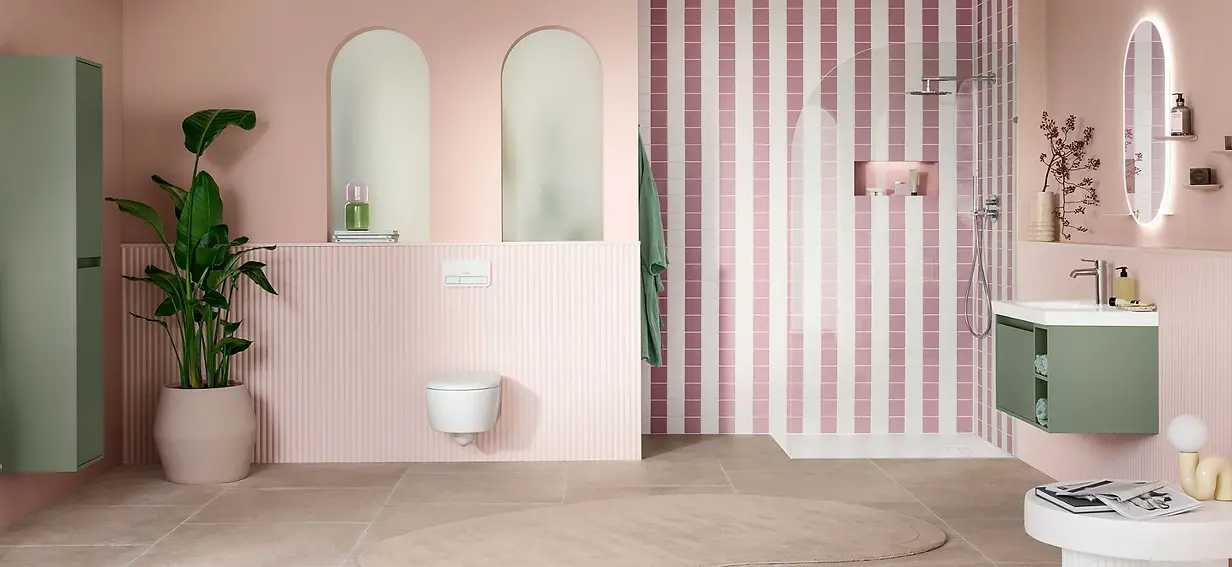
The bathroom is a place that invites personal style and creativity to flourish. With Skyla, Villeroy & Boch introduces a collection that turns versatility into a principle of design, opening up countless possibilities to shape a room that feels truly individual.
Red Dot Design Award 2025
Honoured with a Red Dot Design Award 2025 in the category of Product Design, Skyla stands for innovation and timelessness in bathroom design. The award affirms the collection’s success in balancing versatility, style and quality.


With Skyla, Your Bathroom Reflects Your Style
Villeroy & Boch Skyla redefines the possibilities for bathroom design. Its versatile character adapts to every style and budget, offering a wide choice of furniture surfaces, finishes and a contemporary design language that blends soft curves with defined edges. It’s a collection that leaves every possibility open, making it easy to design a bathroom that’s uniquely you.

SKYLA
Variety Across Every Product Category
Villeroy & Boch Skyla opens up an entire world of bathroom design. Washbasins, furniture, taps, wall-mounted WCs and bidets come together in a collection where every element contributes to a greater whole. The harmony between product categories makes planning intuitive and ensures freedom to create spaces that feel both cohesive and individual. With Skyla, bathroom design becomes clear, inspiring and flexible.

Washbasins with character
Skyla washbasins showcase the collection’s versatility.. Available in multiple sizes and two ceramic finishes, glossy and matt, they balance crisp contours with soft curves in pleasing visual harmony. A choice of designs offers flexibility in planning and room for personal expression. Details such as oval overflows and asymmetric forms add subtle yet striking accents.
FINISHES THAT DEFINE THE LOOK
Matt Black - A Statement In Modernity
Matt Black taps add a modern edge to the bathroom, contrasting with light surfaces and natujral tones for a confident, contemporary feel. As part of Skyla, this finish opens the door to an assured, trend-forward look.

CERAMICS DESIGNED WITH SELF-EXPRESSION IN MIND

From Radiant White To Pure Black
Skyla ceramics come in a carefully balanced palette of White Alpine in gloss, Stone White in matt and Pure Black in matt, offering moods from timeless brightness through to soft calmness and bold contrasts. Also available with Villeroy & Boch’s innovative, dirt-repellent CeramicPlus surface.

Lines And Curves In Harmony
Skyla’s design language artfully balances defined edges with soft curves. Washbasins combine distinctive geometries with refined details such as oval overflows or asymmetric bowls. WCs are available in both square and round forms . Mix and match freely to create a bathroom that reflects you.
SKYLA
Colours Made For Your Style
Colours shape the many faces of the Skyla collection. With eight furniture surfaces to choose from, the range spans from light to dark, subtle to expressive. Scandi interiors gain calm brightness; Boho is enriched by warm, earthy hues. Each surface creates its own mood, allowing individuality to flow effortlessly into bathroom design.
Brilliant white – timeless clarity
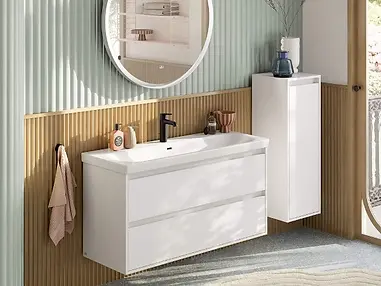
Brilliant White enhances Scandi-inspired bathrooms with light and clarity. Its glossy surface reflects brightness and creates an atmosphere of openness and calm. Paired with minimal lines, it offers a timeless, versatile base for interiors that feel both fresh and sophisticated.


COLLECTION
ANTAO
EXPERIENCE NATURE IN YOUR BATHROOM
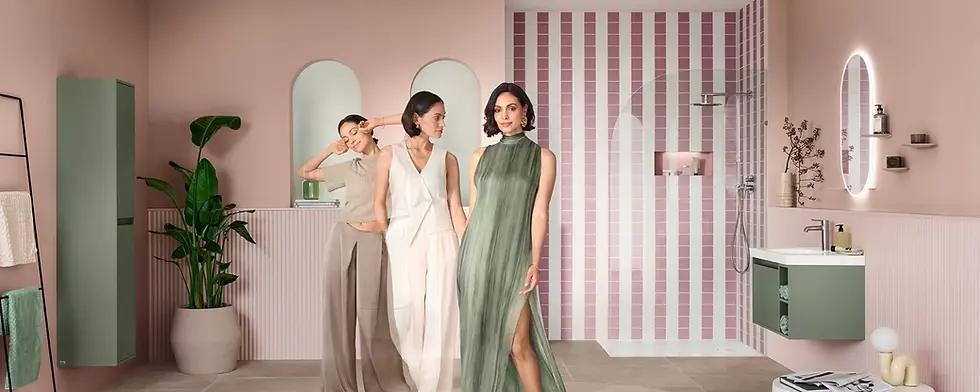
Close your eyes. Picture yourself beside a mountain lake, breathing in the clear air, feeling the warmth of the sun on your skin or listening to the soothing melody of a summer shower. Nature is our greatest muse, our refuge and our source of energy. And it is precisely this amazing feeling that we are seeking to bring you with the Antao collection.
The Inspiration Behind The Design
In an increasingly fast-paced and often unpredictable world, we yearn for a peaceful sanctuary, a retreat where we can simply experience the moment. Antao is more than just a bathroom collection – it is an invitation to leave everyday stresses behind and step into a haven of relaxation. A place to gather strength and revitalise your senses. Because true beauty lies in harmony with nature.

ANTAO
The Difference Is In The Detail
What makes the Antao collection stand out from the others? It is the harmonious fusion of natural design and excellent detail that is the hallmark of each item in this exceptional collection.

Shapes inspired by nature
Softly flowing, asymmetric contours reminiscent of the organic beauty of natural shapes will create a striking look in your bathroom.
Discover The Variety Of Antao

Washbasins
For a fresh start to the day – organically shaped and available in different colours.

Taps
Inspired by water – available in different designs and finishes

Toilets
A fusion of design and comfort – with innovative flushing technology

Baths
A sensory experience – in high-quality Quaryl® for streamlined design and high comfort

Mirrors With Integrated Lighting
For a fresh start to the day – organically shaped and available in different colours.

Bathroom Furniture
Stylish combinations – with soft shapes and smart features
The Perfect Choice For Every Style
From minimalist to modern or rustic – harmonising perfectly with every style, this collection will transform your bathroom into a real wellness retreat. Countless combination options make it ideal for everyone who wants to express their own individual style. Solutions are available for all types of bathrooms, with the extensive furniture range creating a particularly striking effect in larger bathrooms.
